“This small community is responsible for one of the biggest conservation achievements of 2020."
Wikimedia CommonsThe British territory Tristan da Cunha as photographed from space .
The little volcanic island ofTristan da Cunhais a British settlement locate in the middle of the Atlantic Ocean between Brazil and South Africa . know as the “ most remote inhabited island on Earth , ” the island territory has just become one of the big marine protect areas ( MPA ) in the humanity .
According to theGuardian , the island is home to a community of 250 mass , where fully - protected nautical wildlife conservation measures are have place . Bottom - trawl sportfishing , deep - sea excavation , and other hunt activities arecompletely bannedfrom 242,181 square international nautical mile of its ocean territory .

Wikimedia CommonsThe British territory Tristan da Cunha as photographed from space.
The island and its waters encompass an field that is three times the sizing of the U.K. , making it the fourth - largest wildlife sanctuary in the reality and the largest no - take zone in the Atlantic Ocean .
“ Our aliveness on Tristan da Cunha has always been based around our kinship with the sea , and that continues today . The Tristan community of interests is deeply attached to preservation : on land , we ’ve already adjudge protect position for more than half our territorial dominion , ” said James Glass , Tristan da Cunha ’s chief island-dweller .
“ But the sea is our vital resource , for our economy and ultimately for our long - condition survival . That ’s why we ’re fully protecting 90 percent of our waters – and we ’re majestic that we can play a key role in preserving the health of the ocean . ”

The National Audobon SocietyThe island is home to some of the richest biodiversity in the world including the endangered yellow-nosed albatross.
The National Audobon SocietyThe island is plate to some of the richest biodiversity in the world including the endangered yellow - nosed albatross .
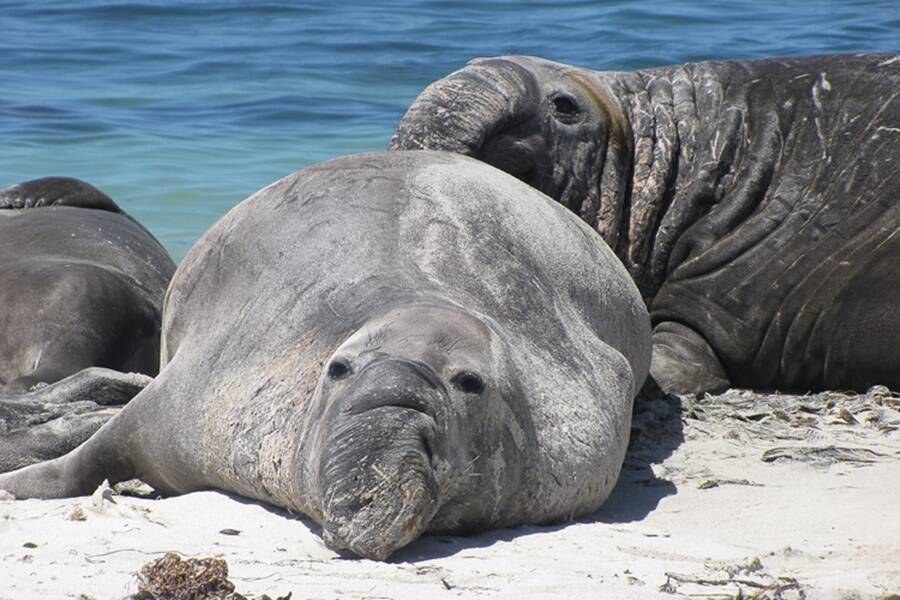
Tristan da Cunha possesses some of the rich biodiversity in the world . Its waters are home to vital coinage , like elephant seals and the broadnose sevengill shark . Its land is an important environment for hoot like rockhopper penguin , which are categorize as a vulnerable specie , and the yellow - nosed albatross , which is peril .
As a British territory , Tristan da Cunha ’s transition into an MPA makes the U.K. custodians over one percentage or roughly 1.6 million square miles of the world ’s protected oceans . It ’s a significant footmark toward the government activity ’s goal of protect 30 pct of the world ’s ocean by 2030 .
NOAAThe island is now the fourth-largest conservation territory in the world.
The Royal Society for the Protection of Birds ( RSPB ) , the U.K. ’s declamatory nature conservation brotherly love , visit the island the “ jewel in the crown of U.K. marine protection . ”
“ Tristan da Cunha is a position like no other , ” said RSPB Chief Executive Beccy Speight . “ Tens of million of seafowl sailplane above the waves , penguins and seals cram onto the beach , threatened sharks breed offshore and mysterious whale feed in the bass - body of water canyons . From today , we can say all of this is protected . ”
The move is a resultant role of a ten - farsighted partnership involving both governments as well as the RSPB and an outside consortium of cooperator including National Geographic and the Blue Marine Foundation .
NOAAThe island is now the fourthly - tumid preservation territory in the reality .
But the move has still dissatisfy some who point to the U.K. government ’s want of wildlife protection back home .
“ We welcome the administration ’s efforts to get more nations sign up to protect 30 per centum of their seas , ” said Melissa Moore , head of policy at Oceana UK . “ However , it is ludicrous to support protection oversea but not in UK waters – they must also protect all UK marine protect country from detrimental activities like bottom trawling , just as Tristan da Cunha will . ”
Tristan da Cunha was firstdiscoveredin 1506 by the Lusitanian adventurer Tristão da Cunha . In the 19th century , the island was claimed by the British , who build a garrison there to keep endeavour to rescue Napoleon Bonaparte , who was immure on St. Helena island 1,500 mile aside . After the William Lloyd Garrison was removed , some British soldiers stayed and built a community .
Today , its 250 inhabitant are mostly British citizen whose ancestries uprise from Scotland , America , the Netherlands , and Italy , descend from seafaring ancestors who made their way to the removed patch of land .
Now , this faraway island is also one of the most crucial ecological bema on Earth . As Beccy Spight , chief executive director of the Royal Society for the Protection of Birds , put it , “ This small-scale community is responsible for one of the biggest conservation achievements of 2020 . ”
Next , read how conservation effort arepushinglarge predators into new territories and check out the hundreds of “ extinct ” creatures that wererediscoveredin the thick forests of Honduras .
