When you purchase through links on our land site , we may earn an affiliate delegacy . Here ’s how it works .
An observational flexible implant that plug in directly to the spinal corduroy might someday lead to a treatment for people with spinal corduroy injuries , and could possibly aid hoi polloi with paraplegia move again , research worker say .
Now , research worker at the Swiss Federal Institute of Technology in Lausanne have construct such an implant . They call the gentle , stretchable gadget " Es - dura , " after the dura mater , which is one of the layers of protective membranes that fence thebrain and spinal corduroy . The researchers implant the gimmick into rats — it rests on the spinal cord , and delivers electric signals , as well as drug , to the surrounding nerves , triggering them to fire urge .
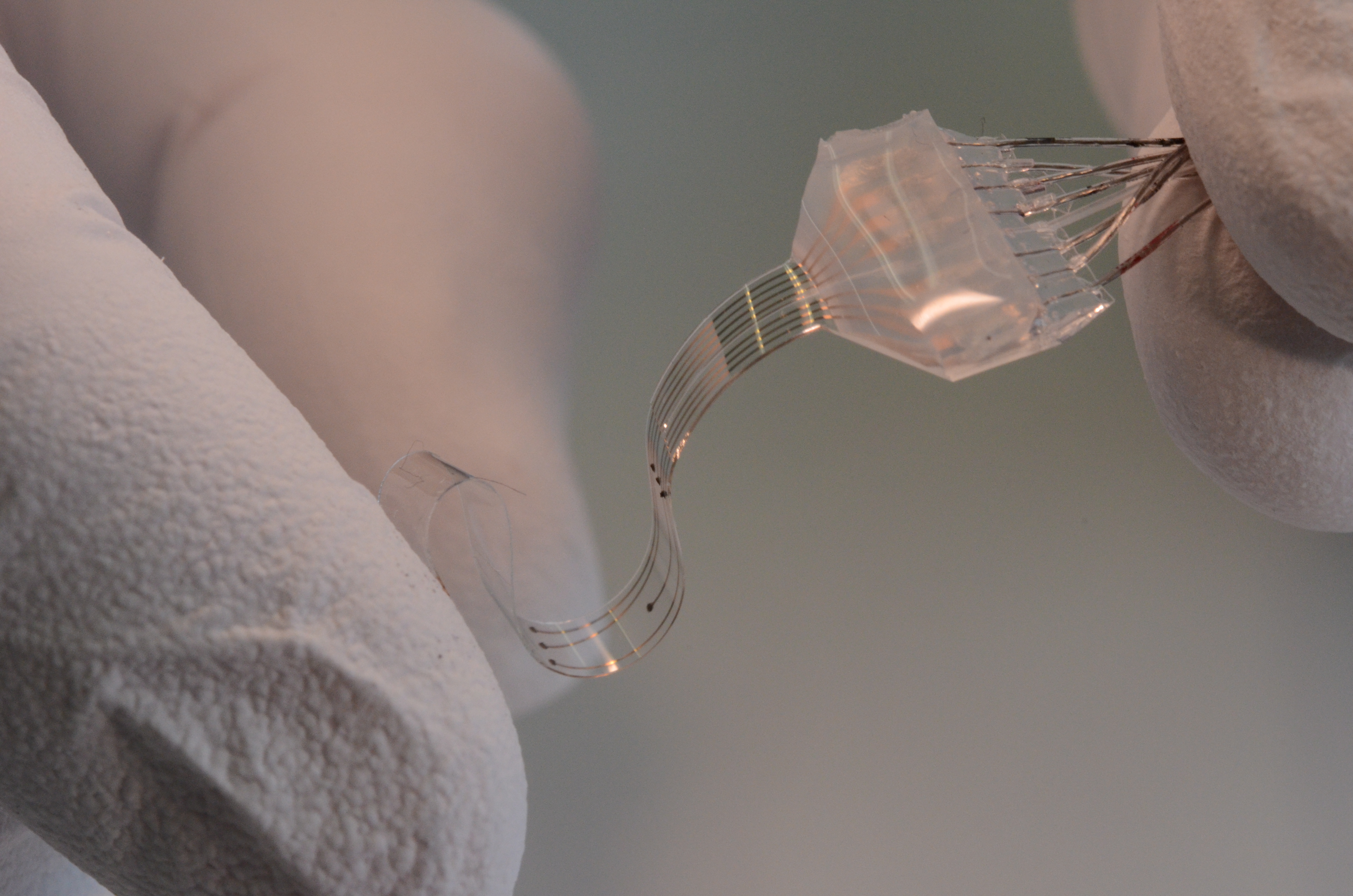
The e-Dura implant
In experiments , paralytic rats that were implanted with the equipment retrieve the ability to walk , with some assistant .
Previously , it had been difficult for scientists to rule a mode to connect anelectronic gadget to the spinal cordwithout damaging it . One obstruction is that electronics are made of stiff fabric , whereas the spinal cord and its protective covering are more flexible .
" The spinal electric cord expands and relaxes , " saidStéphanie Lacour , chairwoman ofneuroprosthetic technologyat the institute and one of the leaders of the newfangled enquiry . " If you have a hard , nondeformable material , the rubbing and rub cause lighting . "

The e-Dura implant is soft and flexible.
To make the e - dura , Lacour ’s squad used a polymer for the implant ’s canonical structure , and gold for the electrode . The implant also has tiny channel for drug manner of speaking . [ 5 Crazy Technologies That Are Revolutionizing Biotech ]
Although amber is flexible , it does n’t stretch . To make the metal more elastic , the researchers laid it down in layer just 35 nanometers ( 0.000035 milimeters ) thick , with tiny fissure in the layers . This turn the gold into a meshlike social system that could elongate .
To try the implant , the scientists did a series of experiments on scum bag . First , the research worker calculate at whether the e - dura integrated well with the rat ' bodies , to minimize the chance that their eubstance would turn down it . They tested three groups of animate being : one that was implant with the e - dura , a second that got an implant made of a stiffer fabric and a third that underwent surgery but received no implant . ( The third radical process as a control . )

The research worker find that , even after eight week , the e - dura mater had not make any contortion of the fauna ' spinal cords , nor had it actuate an immune system reaction , such as kindling . The implant that were made of the steady material cause changes in the spinal electric cord ’s shape , contract and rubbing on it , and producing a " foreign body " immune response . The informer also had trouble walking and balance .
In previous workplace , other researchers had demonstratedmind - controlled prosthetic arm , and the U.S. military is looking at implant tohelp soldiers with head injury . And devices such as cochlear implants and pacesetter have assist nitty-gritty patients for years .
But most implants that mix with the anxious system are made to rest on the outside of the dura mater . In line , the e - dura mater can be inserted below the dura mater , immediately in impinging with the nerve tissue paper .

neuronal impulses
The 2nd part of the newfangled inquiry was to test the power of the vitamin E - dura to memorialise neural impulsion . The research worker inclose the gadget into the place where the dura mater unremarkably is , next to the rats ' motor cerebral mantle — the region of the brain that controls voluntary movement — and found what variety of signals generated in that brain region were associated with therats ' intention to move their legs , or stand still . The implant exhibit that it could " read " the signals .
" It ’s about receive a path to get the correct sign from the brain — to really get precise measure or transcription of the intention of walking , " Lacour said .

Lastly , the researchers tested the e - dura ’s ability to ferment with the motor brass . First , the investigator impose spinal wound on the rats that mimics the case many human beings get in chance event , call a contusion . Then , they inclose the vitamin E - dura into the dura mater below the combat injury situation . The rats receive both electrical stimulation and doses of the head chemical serotonin via the due east - dura .
Within a few weeks , the rats were able-bodied to walk again , with assistance from the machine that supply the stimulus . The rats were not controlling the motion of their leg ; rather , the machine was foot up artificial signals and get them to the nerve .
" The importance of this paper , in my view , is that it provides a very powerful case that soft mechanics is critically of import to the proper cognitive operation of implants of this division , " saidJohn A. Rogers , a prof of materials science and technology at the University of Illinois , who was not involve in the enquiry .

Even though the work go a long agency toward helping researchers forecast out how to design spinal implants , there ’s a circumstances of work to do before these devices can avail human patients . For one thing , the rats had to be physically connected to a foreplay machine to walk . " We want to get rid of the wires , " Lacour said .
There was also no voluntary movement . For a genuine discussion , researchers would need actual sign from the brain , rather than an outdoor twist to could hold in a patient role ’s movement .
The research is published in the Friday Jan. 9 issue of the journal Science .


