“We tend to underestimate the geographical knowledge of past societies. This slab is important, as it highlights this cartographical knowledge.”
National Institute of Preventive Archaeological ResearchFound in 1900 , the Saint - Bélec Slab was never properly analyse until now .
In 1900 , archeologist Paul du Chatellier was excavating a prehistorical sepulture terra firma in northwestern France when he made the discovery of a lifetime , unearth the Saint - Bélec Slab . The Bronze Age piece of rock was covered with left markings that have only now been divulge as Europe ’s oldest 3D mathematical function .
It ’s no wonder why experts failed to properly analyze the find before , according totheBBC . The Saint - Bélec Slab seemed to vanish after its excavation . ab initio adopt by a private collector , it was buy by France ’s Museum of National Antiquities and then lay entomb in the moat of a castle until 2014 .

National Institute of Preventive Archaeological ResearchFound in 1900, the Saint-Bélec Slab was never properly analyzed until now.
Rediscovered by dedicated archaeologists , the remarkable Bronze Age rock has been pored over ever since . According toThe Independent , the Saint - Bélec Slab has been go steady to the Early Bronze Age , between 1900 and 1650 B.C. , and is thus formally t7he oldest map ever discover in Europe .
While that ’s for certain becharm on its own , the weighty map ’s etching are even more astounding . As a studypublishedin theBulletin de la Société Préhistorique Françaiseexplained , the slab showed an surface area of 13 by 18.5 miles — with motifs that elaborate roads , settlement , river , and a burial mound .
France ’s National Archeology MuseumResearchers photographing the sculpture in 2017 .
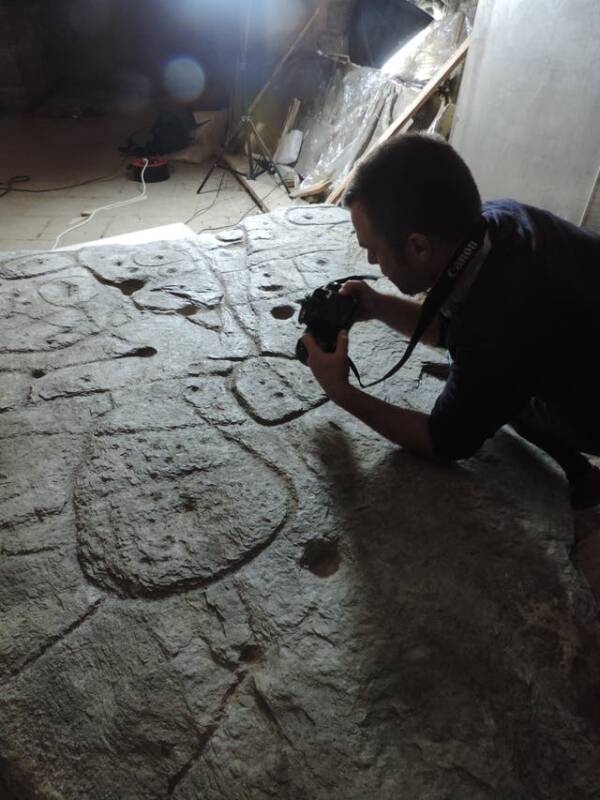
France’s National Archeology MuseumResearchers photographing the carvings in 2017.
It ’s unclear if Paul du Chatellier was aware of the rock ‘n’ roll ’s age when he found it , but the 1900 discovery was certainly exciting enough for archaeologists to vie for it . After unearthing the slab during dig in Finistère , on the French peninsula of Brittany , du Chattelier sold it a individual museum for a presumptively hefty substance .
Although France ’s Museum of National Antiquities acquired the detail in 1924 , it was later bury in a chateau fosse until the 1990s . As the BBC reported , the Chateau belonged to du Chatellier himself — suggest reacquisition or some variety of agreement allowing him to guard it .
at last , the noteworthy item was rediscover in the cellar of that castle by obsessive researchers in 2014 . While it was clear that the slab date to the Bronze Age , the significance of its sculpture was only discovered in 2017 , using even more advanced engineering .

National Institute of Preventive Archaeological ResearchThis particular crevice perfectly matches a particular stretch of the River Odet valley.
High - resolve 3D scans brought millenary - quondam mysteries to light and indicate clear motive that experts have since render as specific locations . From the center of the resolution — which was situated where the Odet , Isole , and Stêr Laër rivers meet — they identify river networks , roads , field , and more .
Experts hold the some 19 - Admiralty mile map of Finistère to be 80 per centum accurate .
National Institute of Preventive Archaeological ResearchThis finicky crevice dead correspond a particular stretching of the River Odet vale .

National Institute of Preventive Archaeological ResearchThe map was found to represent a Finistère area measuring 13 by 18.5 miles with 80 percent accuracy.
“ This is probably the one-time function of a territory that has been identified , ” said Dr. Clément Nicolas , of Bournemouth University . “ There are several such maps chip at in stone all over the world . Generally , they are just interpretations . But this is the first fourth dimension a function has depicted an area on a specific scale leaf . ”
Nicolas is one of many experts who joined in the endeavor to analyze this map . scientist from the University of Bournemouth and French National Institute for Preventative Archaeological Research , the French National Center for Scientific Research , and the University of Western Brittany were also on board .
On its face , the Saint - Bélec Slab itself is nothing but a well - preserved objet d’art of onetime rock that is six in thickset and beat five by six - and - a - half feet . In proper circumstance , however , it connote just how advanced prehistoric order really were in their reason of mapmaking .
According toBournemouth University , it was made around the same time of the Nebra sky disk , which depicts the cosmos and was found in Germany in 1999 . While the slab was found to have been used in a Bronze Age burial to form one of the walls of a casket , experts are most curious about its political consumption .
National Institute of Preventive Archaeological ResearchThe single-valued function was incur to exemplify a Finistère surface area measuring 13 by 18.5 mi with 80 percent truth .
“ It was in all likelihood a way to assert the ownership of the territorial dominion by a small prince or king at the fourth dimension , ” Nicolas said . “ We lean to underestimate the geographic knowledge of retiring societies . This slab is important as it spotlight this cartographical knowledge . ”
Just as the slab ’s learned depiction of the territory was used as a sign of power over the orbit , so would its burial suggest a trouncing of the elite group who reigned over it . According to Bournemouth University researchers , at least , lay to rest the rock ‘n’ roll may have sign the end of a rule ’s reign .
at last , researchers are overjoyed at the diaphanous preservation of this detail . The Saint - Bélec Slab showed little , if any , endure at all , which suggested that it had been buried shortly after it was made . With the coolheaded and dark surround of various museums and a castle basement , that sure as shooting makes gumption .
After read about the Bronze Age stone slab constitute in France , learn aboutresearchers finding the oldest - ever bracelet alongside an nonextant human species . Then , record aboutthe earth ’s previous beer brewery , unearthed at an ancient Egyptian sepulture site .
