eminent energy photon in all likelihood originating from the nascence of a black holebriefly change the Earth ’s upper atmospherelast year , despite occur billion of light years aside . A set of theme delve into the explosion astronomers dub the BOAT ( promising Of All Time ) reveal it far outshone anything we ’ve seen before , and was play along by a befittingly telling afterglow .
GRB 221009A was so lustrous it overloaded satellite ' gamma - ray sensing element . As a outcome , astronomer instantly screw it was very powerful , but could not appraise it precisely . telescope operating across the electromagnetic spectrum abruptly changed direction to see what they could find . Some of the resulting oeuvre has now been released in a paper in theAstrophysical Journal Letters , while other decision are still work their way through peer review , but are available as preprints .
Longer Gamma Ray Bursts ( GRBs ) are consequence of mordant holes being take form , although GRBs lasting less than two bit can have othercauses . The formation of a black trap from the collapse of a jumbo star releases enormous amounts of energy , but GRBs are also lustrous because most of this actinotherapy escapes in the form of narrow honey oil . If Earth falls within the beam of these spurt , we get bathe in gamma shaft , and if not we usually would n’t know anything happened .

X-rays from GRB 221009A’s initial flash were reflected off dust, allowing us to see it for over a week. Image Credit: NASA/Swift/A. Beardmore (University of Leicester)
GRB 221009A definitely come down into the prospicient - duration GRB category , hold out a whole five minutes . Indeed , as University of Sydney PhD student James Leung tell apart IFLScience , it is thought that part of the reason it was so shining is that the chemical mechanism power the GRB stayed on longer than usual . In add-on , Leung said , the explosion was relatively tight to us ; “ About a thousand times as remote as the Andromeda Galaxy , ” or 2.4 billion unaccented class forth . Immense as that space is , it ’s still closer than 97 per centum of GRBs .
The University of Sydney ’s Professor Tara Murphy said in astatementthat " One of the entrancing things about gamma ray fit is , although they are over quite quickly - in just a matter of moment - they allow for afterglow emission across the light spectrum in surrounding matter that echo for months and years afterwards . " The afterglow is bring on by the jets collide with natural gas thrown off by the former star .
GRB 221009A ’s afterglow was undimmed , but also puzzling . The visible and X - ray parts of its spectrum were unusually faint proportional to the extraordinary strength of its receiving set and millimeter waves . “ A few GRBs in the past have shown a brief excess of millimeter and radio emission that is call up to be the touch of a shockwave in the jet itself , but in GRB 221009A the excess emanation behaves quite differently than in these retiring guinea pig , " said Dr Yvette Cendes of the Harvard - Smithsonian Center for Astrophsyics , in astatement .

Gamma rays detected from GRB 221009A compared to the previous five record holders. Even the afterburst outshone anything before. Image Credit: NASA’s Goddard Space Flight Center and Adam Goldstein (USRA)
Leung order IFLScience that GRB good example will postulate to be rework to account for this lesson . Although ideas are being considered , no net conclusions have been reached .
We ’ve only been keep GRBs since we could put sensing element on satellite , but astronomers gauge GRB 221009A was a one - in - a - thousand - yr result , if not rare . GRBs ’ intrinsical light are determined by factors such as the quite a little and pace of spin of the star before it collapsed . Leung told IFLScience that some researcher have also found grounds GRB 221009A ’s spurt was remarkably tightly focussed , contributing to its sinful light , but this stay contend .
Astonishing as this consequence was , it has left astronomers wanting more . Leung recite IFLScience that long - GRBs ' cause was confirmed because some were encounter to be co - turn up with supernovas . However , in the case of GRB 221009A , “ The supernova has proven elusive . ” The reason for this is unnamed , but Leung said some astronomers ascribe it to dust blocking out visible luminousness from the direction of the plosion . “ Another theory is the fatal hole spring so tight there was not time for a significant supernova contribution , ” Leung added .
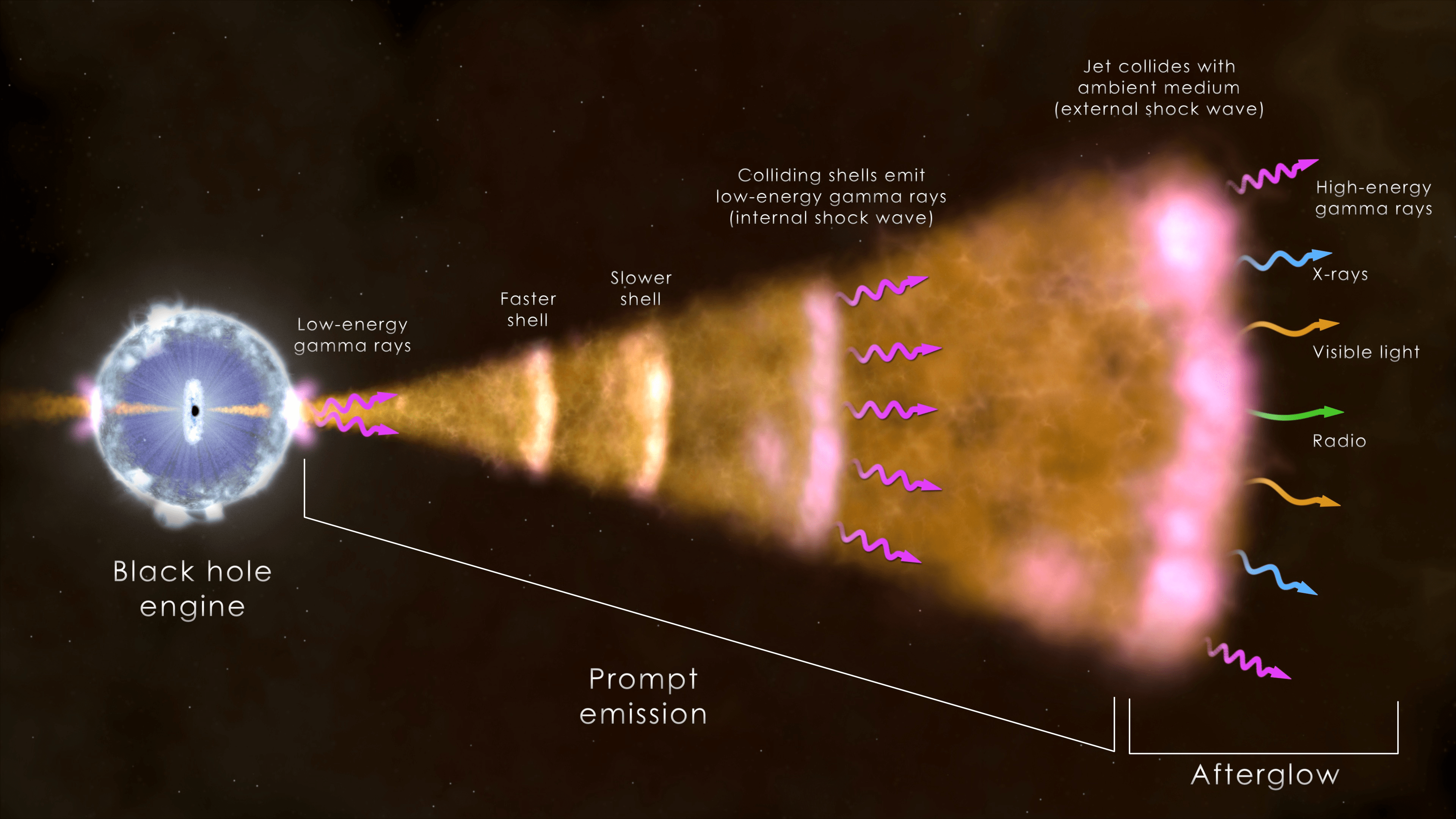
Schematic of long gamma-ray burst. A giant star collapses into a black hole, releasing a few minutes of gamma rays, which collide with surrounding gas and dust to produce an afterglow lasting days. Image Credit: NASA’s Goddard Space Flight Center
Some of the piece of work discussed here is open approach inThe Astrophysical Journal Letters
Leung and Murphy ’s study has been submitted toNature Astronomy , and is currently useable onArXiv.org
