A fragment of 10,000 - year - old dog bone found along the Alaskan coast could be the oldest evidence of domesticated dogs in North America , and potential evidence of a coastal route read by the first people to cross into North America from Eurasia .
The evidence continues to mount for the Coastal Migration Theory , which purpose that Eurasiatic migrator , or else of traveling through an interior corridor between two melting chalk sheets , hugged the Siberian , Beringian , and Alaskan coastlines . These settlers continued their way along the Pacific coast , eventually connect with the southernmost boundary of the massive Cordilleran Ice Sheet , accord to this hypothesis .
The Coastal Migration Theory , also know as the Kelp Highway Hypothesis , is supported bygeologicalandarcheologicalevidence , including29 human footprintsfound on the shoreline of Calvert Island in British Columbia . We now have further grounds to support this theory , but it comes from an unexpected source : a domesticated pawl .

The canine bone fragment, found in Southeast Alaska.Image: Douglas Levere/University at Buffalo
This wienerwurst died roughly 10,150 age ago in what is now Alaska during the very tail - end of the last Ice Age . The lonesome fogy — a art object of a thighbone — is now the oldest confirmed remnant of a tame dog in the Americas , according to the new research , go by evolutionary biologist Charlotte Lindqvist from the University at Buffalo . The paper describing this find was published on Tuesday in Proceedings of the Royal Society B.
That Alaska was host dog around this time is not a huge surprisal . Research from 2019 presentedevidenceof three prehistoric dogs found buried in what is now Illinois , which were date to between 9,630 and 10,190 eld ago , the latter chassis suggesting a date slightly older than the particular date presented for the thighbone in the newfangled paper . I postulate Lindqvist about this apparent variant .
https://gizmodo.com/new-evidence-suggests-dogs-reached-north-america-10-000-1831576469
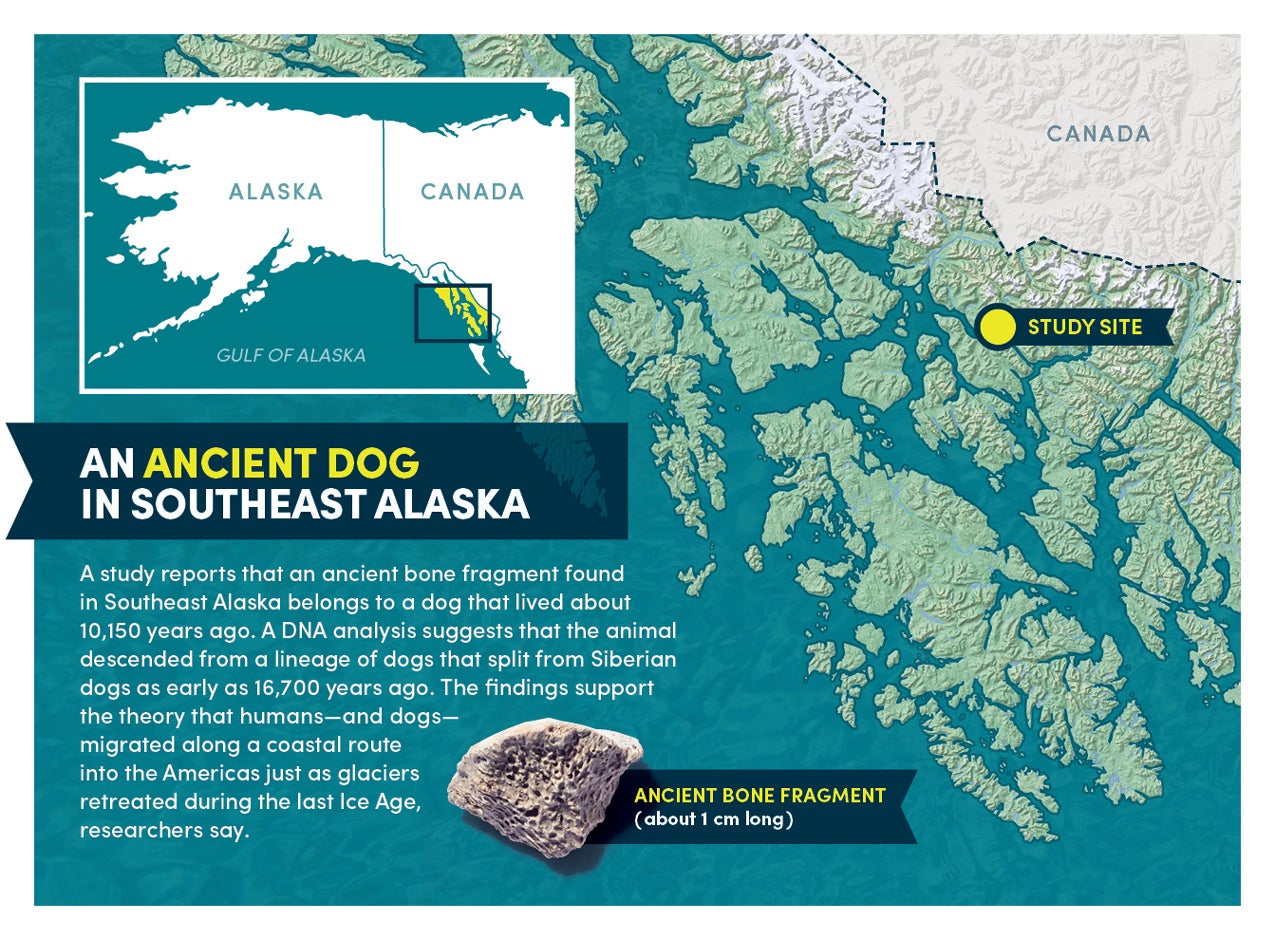
A map showing where the bone fragment was found.Image: Bob Wilder/University at Buffalo
“ When you liken the median radiocarbon date of the Illinois dogs and our dog , the Alaskan click is a fiddling older , ” she articulate . “ But it does depend on what you are compare , and with the error bars and precariousness — and radiocarbon dating done by different labs — you’re able to argue that they are at least tightlipped to the same age , possibly with the Alaskan detent being a couple hundred eld old . ”
The Illinois dogs are significant , because they suggest the first settlers of North America brought their dogs with them from Eurasia . old geneticresearchdone in this sphere came to a like last , showing that dogs arrived in the Americas approximately 10,000 years ago .
Lindqvist and her co-worker unwittingly stumbled upon the thighbone while sequence DNA from a jumble of fauna off-white excavated from caves in southeast Alaska . This research is being done to determine how climatic alteration during the last Ice Age affected various coinage , including their mobility .

University at Buffalo PhD student Flavio Augusto da Silva Coelho holding the fragment.Image: Douglas Levere/University at Buffalo
“ One of the undertaking I work on involves black and brownish bear and we ab initio think the bone come from a bear , but we later on come upon it was a dog , and we had to come up on this determination , ” explicate Lindqvist in an electronic mail .
The dogtooth femur fragment , designated PP-00128 , was found on the southeast Alaskan mainland just east of Wrangell Island in a fix known as Lawyer ’s Cave . Lindqvist , with her conscientious objector - writer Timothy Heaton , a professor of Earth skill at the University of South Dakota , conducted a number of excavations in the late 1990s and early 2000s , lead in the discovery of this osseous tissue and many others from this same cave .
The team was able to derive a complete mitochondrial genome from the fragment , which they compared to modern dog breeds , historical gelid dogs , and American pre - contact dogs ( i.e. dog that lived in the Americas prior to the arrival of Europeans ) . Mitochondrial DNA comes only from the enate side , so it ’s incomplete ( as compared to nuclear deoxyribonucleic acid ) , but the scientists were able to trace the genome back to a lineage that diverge from Siberian dogs around 16,700 years ago .

That ’s pregnant , as this “ timing roughly coincides with the minimum intimate date for the opening move of the North Pacific coastal route along the Cordilleran Ice Sheet and genetic evidence for the initial peopling of the Americas , ” as the authors compose in the study .
Indeed , the PP-00128 fragment presents another clue in favor of the Coastal Migration Hypothesis . The coastal bound of the deoxyephedrine sheetstarted to melt around 17,000 years ago , while the inland corridordidn’t open up until around 13,000 years ago .
“ Previous genetic estimate of the rip between pre - European American dogs and their Siberian ancestor were younger than the estimates of when the ancestral native American human universe diverged from their Siberian ancestors , suggest dogs arrived in late migrations of humanity into the Americas , perhaps even along the inland corridor , ” explained Lindqvist .

Before the new study , “ the oldest American wiener remain were found from mid - continent site , not suggest how they convey there , ” she said , but this latest find “ supports that our coastal frump is a descendant of dogs that participated in this initial migration along the Northwest Pacific Coast . ”
A possibleness live , of course , that this was a rogue dog that somehow made its way to North America without human being . That ’s not as outlandish as it might seem ; dogs were tame from wildcat between 14,000 and 29,000 days ago , in a complex appendage that involved multiple interbreeding episodes between dogs and wild brute . That read , Lindqvist believes her Alaskan hound likely know with humans .
“ Other remains excavated from this same cave include human bones and artifacts , but these are all younger , ” she said . “ They do suggest , though , that the cave was indeed used by humans . And we know from human remains found in another cave in southeast Alaska that humans were in the region at the time this ancient dog dwell . But no , we do n’t have direct evidence that this dog was know with humans . We do know , though , that this dog was a domesticate and not a wolf , and if I were a dog , I would in all likelihood stay put around humans for food . ”

https://gizmodo.com/too-much-meat-during-ice-age-winters-gave-rise-to-dogs-1846008092
Indeed , a carbon isotope analytic thinking of the femur fragment intimate this dog was fed by man , as it ate fish ( possibly salmon ) , and meat from whales and Navy SEAL . This runs in stark contrast to other ancient dogs living in the mid - continent , which have a “ much more terrestrial diet , ” said Lindqvist .
Ben Potter , an archaeologist from the Arctic Studies Center at Liaocheng University in China , had some headache about the raw study .

“ We already know through multiple site that southeast Alaska was occupied by 12,600 days ago , which is 2,400 years in the beginning than the dog , ” he explained via email . “ So it is whole uninformative as to routes of the first Native Americans about 4,000 to 5,000 years earlier . ”
This Brobdingnagian time gap , he enjoin , is “ equivalent to the emergence of first res publica in the close East — ancient Egypt and Mesopotamia — and today . ”
To which Potter added : “ Our recap of the data indicate the interior ice free corridor road was available by at least 14,900 class ago . ’

That human beings travel along the Pacific coast from Eurasia into North America seems extremely probable , and the new enquiry fits in nicely with this increasingly popular narrative . But that does n’t mean alternate pathways into the continent were neglected . As Potter aim out , there was likelymore than one routeinto North America , as an national corridor in all probability opened up around 12,600 to 14,900 years ago .
Dogs
Daily Newsletter
Get the best tech , science , and cultivation news in your inbox day by day .
news show from the hereafter , delivered to your present .
Please take your desired newssheet and submit your email to advance your inbox .

You May Also Like


