Kosmos 482 has been trapped in Earth ’s compass for 53 year but its meandering journey is coming to an end . The fail Venus commission is expect to reenter through the atmosphere in a dramatic fall toward its home satellite , where it may stay intact or dispel its bit across a still unknown placement on either side of the equator .
The Soviet - era spacecraft will plunge through Earth ’s atmosphere sometime between May 8 to 12 . As of now , the exact placement of where Kosmos 482 will crash - country on Earth is still unidentified , with a preliminary appraisal that stretches across large parts of the domain on either side of the equator . It ’s also unclear whether the spacecraft will remain in one piece or if it will break apart during reentry , rain down morsel of rubble .
Kosmos 482 set up on March 31 , 1972 from the Baikonur Cosmodrome spaceport in what is know Kazakhstan . The military mission was an attempt by the Soviet space program to reach Venus , but it failed to make enough speed to enroll a transfer flight toward the singe hot major planet . A malfunction resulted in an engine burn that was n’t sufficient to reach Venus ’ celestial orbit , harmonize toNASA . Since then , the space vehicle has been stupefy in an elliptical orbit around Earth . The ballistic capsule entered a higher orbit measuring 130 by 6,089 miles ( 210 by 9,800 kilometers ) .

Artist S View Of Atv 5 ReentryESA/D. Ducros
Astrophotographer Ralf Vandebergh recently captured image of Kosmos 482 in blank onwards of its projected decline , and made a Federal Reserve note of what appeared to be a parachute deploy from the space vehicle . “ At this point nothing is indisputable , ” Vandebergh told Gizmodo in an email . “ In 2014 I had a first sign of this in my images but I did n’t think seriously about this possibility . But when I processed the 2024 images taken 10 years later on and see the same thing , I thought I needed to report this possibility . ”
Cosmos482Note about the chute theory . Although still supposition as mentioned before , technically the effigy are right . There are no tracking issues , orbit issues and I not wait a like atmosperic effect in simulacrum taken 10 years apart , if that would be the case.pic.twitter.com/DiCMzqNY0Z
— Ralf Vandebergh ( @ralfvandebergh)May 6 , 2025
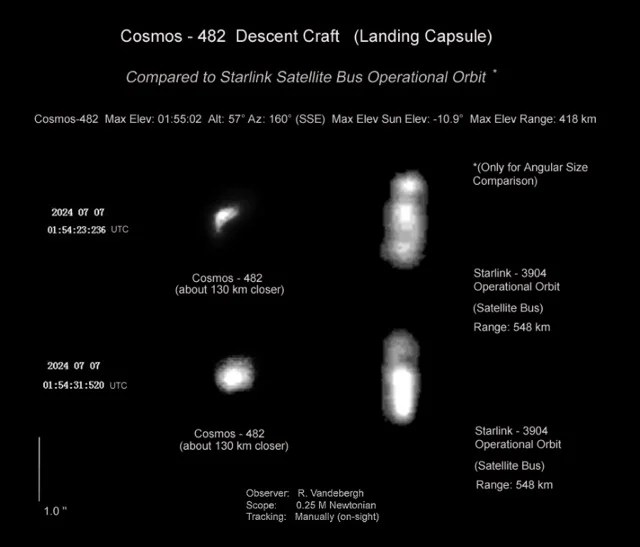
The Kosmos 482 spacecraft, as imaged from Earth. © Ralf Vandebergh
Even if the space vehicle ’s endanger parachute is hanging out in place , it ’s unlikely that it would still do its job of slowing down Kosmos ’ descent toward Earth .
After failing to reach Venus , the space vehicle broke apart into four unlike pieces , with two of the smaller shard reentering over Ashburton , New Zealand , two years after its launch . The two remain pieces are a common carrier bus and a lander probe , which together imprint a spherical press vessel weigh more than 1,000 quid ( 495 kg ) .
Today , it ’s hard to determine where the remainder of the heat - resistant spacecraft will reenter Earth ’s atmosphere . Its current orbit indicates it should be anywhere between latitude 52 degrees north and 52 degrees in the south , allot to Marco Langbroek , a satellite tracker based in Leiden , the Netherlands . That barely narrow down it down as this country let in the United States , South America , Africa and Australia , and most of Europe and Asia to the south of the Arctic Circle . The spacecraft ’s landing zone will become more absolved as it approaches its doomed reentry .

Another query is how much of it will live on the heat of atmospherical reentry . “ As this is a lander that was designed to live on passageway through the Venus atmosphere , it is possible that it will survive reentry through the Earth ambience intact , and impingement intact , ” Langbroekwrotein a blog update .
Langbroek suggests an impact upper of around 150 miles per hour ( 242 kilometers per hour ) if the lander does not split aside or largely burn up during reentry . The energising energy at wallop is like to that of a 15- to 21 - column inch - tenacious ( 40- to 55 - centimetre ) meteorite fragment , allot to Langbroek .
Since our planet is mostly made up of water , the spacecraft will likely end up at the bottom of an sea storey . The chances of it impact an inhabited area , however , are not zero so it does pose some form of risk specially as its reentry date and localization stay incertain .

Russiasatellite reentryspace debris
Daily Newsletter
Get the good tech , science , and refinement word in your inbox daily .
word from the hereafter , delivered to your present .
You May Also Like


