When you buy through links on our site , we may gain an affiliate commission . Here ’s how it works .
Seventeen decapitate skeletons go steady back about 1,700 years have been discovered in three Roman Catholic cemeteries at Knobb ’s Farm in Cambridgeshire , in the U.K.
archeologist who excavated the internet site cogitate that the people were executed for rape Roman laws . However , scholar not assort with the research expressed interracial views about this explanation .
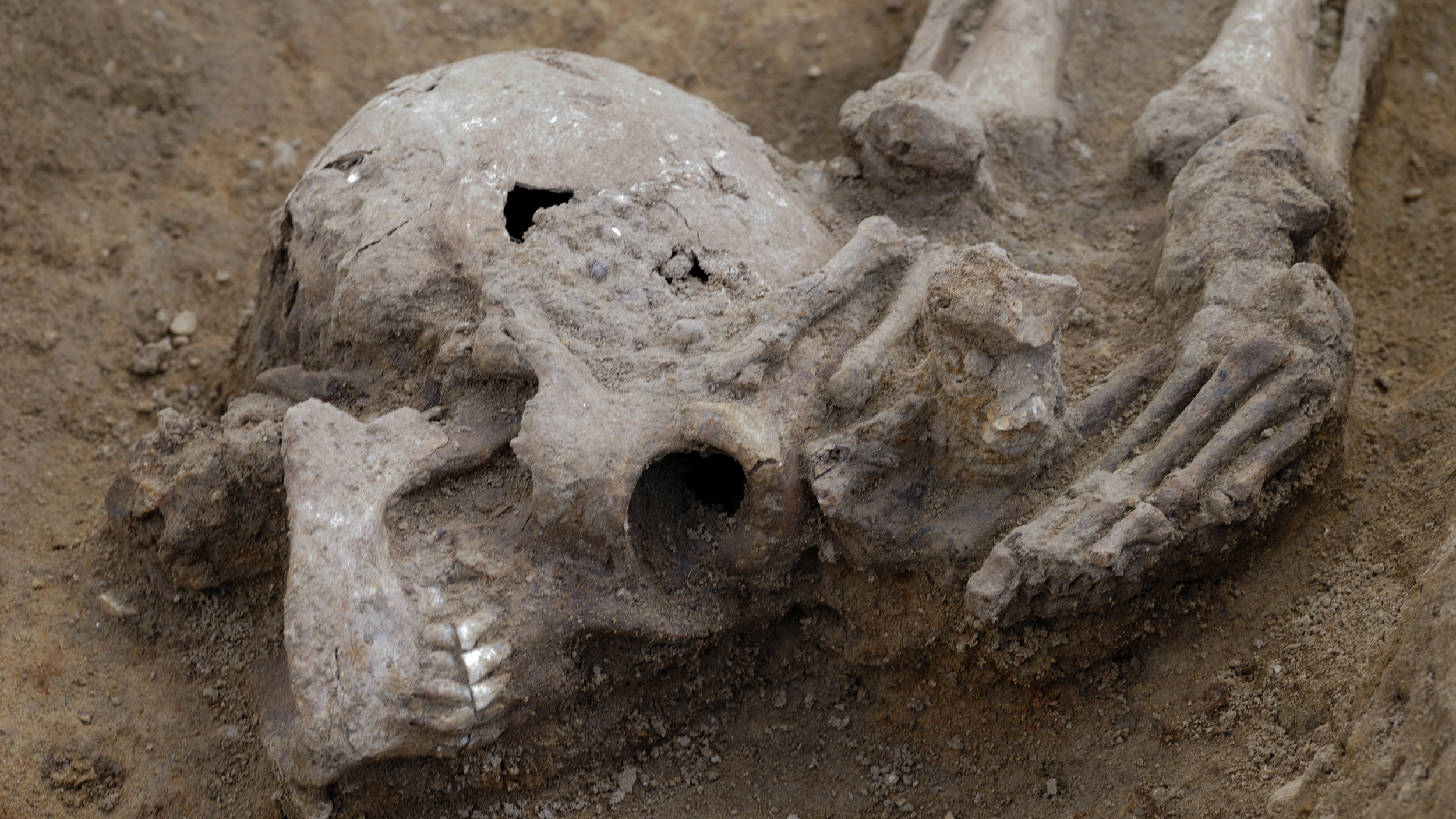
Many of the decapitated skeletons had their heads buried like the one shown here.
The memorial park hold the burials of 52 people , and the 17 decapitated body let in those of nine world and eight women and all over 25 years of old age at time of destruction , a team of researchers reported in a paper published online May 19 in the journalBritannia . In many vitrine , the heads of the beheaded individuals were swallow up beside their feet and pottery was placed where their capitulum normally would have been . Some of the bodies were also place prone ( stomach down ) in their graves .
relate : Photos of decapitated frame buried in a papistical graveyard
The research worker trust that the beheaded hoi polloi were execute . They notice that the act of capital criminal offence in Roman jurisprudence increase dramatically during the third and fourth centuries , around the time these skeleton were buried . Surviving archaeological grounds evoke that the papistic military machine used Knobb ’s farm as a supplying gist , and they would have dealt gratingly with any infractions , the research worker said .
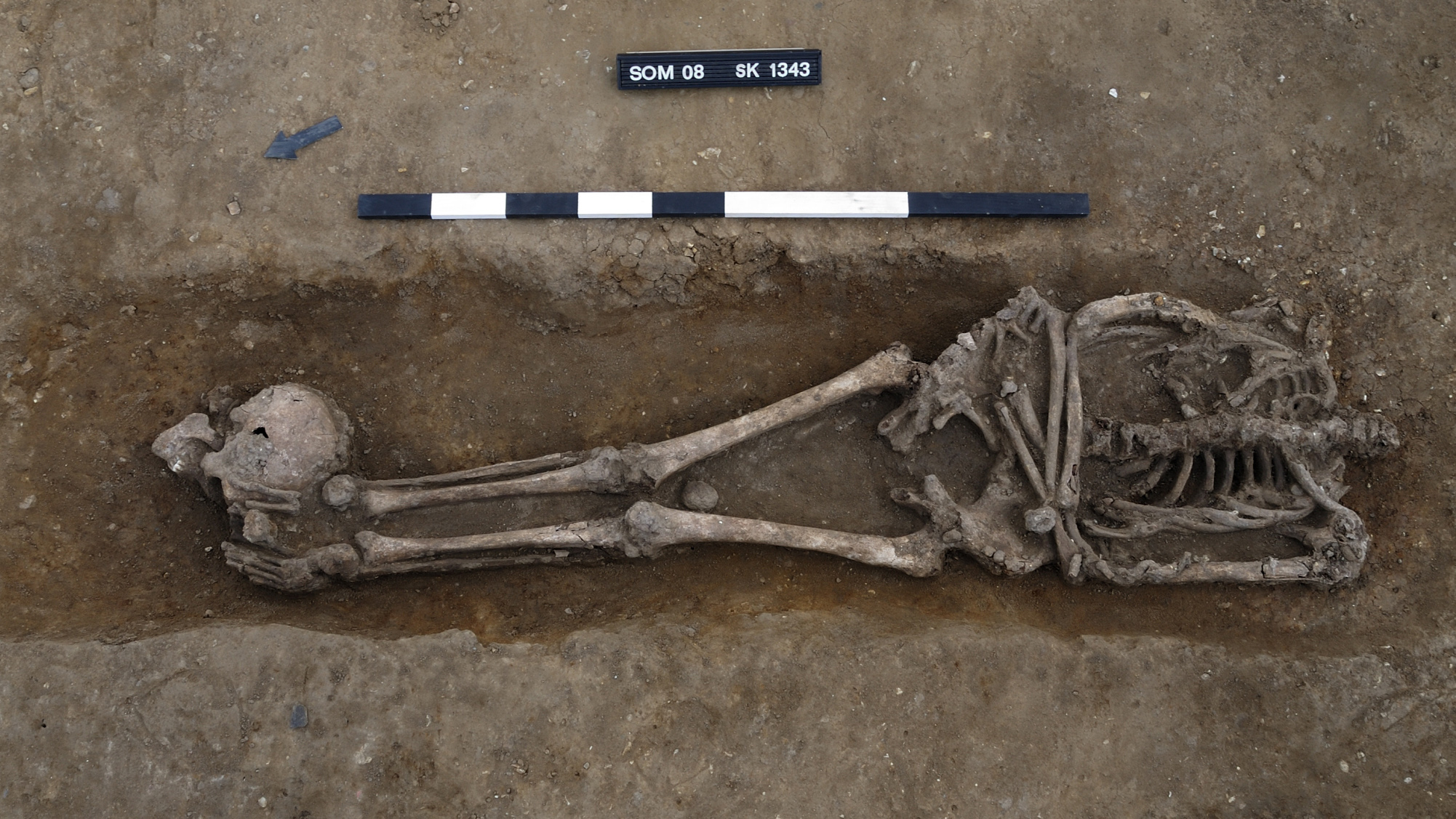
Here, another decapitated skeleton found at the Knobb’s farm site.(Image credit: Dave Webb, Cambridge Archaeological Unit)
" During the third and 4th one C , the penalty available under Romanic law grow steadily harsher . The number of crimes that dribble the death penalty spring up from 14 at the first of the third century to around 60 by the death of Constantine in A.D. 337 , " the researcher write in the diary clause , take note that security concerns were one of the reasons for the increase in the decease penalty . During the third and quaternary 100 there were numerous civil war within the Roman Empire , with multiple citizenry often contend to be name Saturnia pavonia . Additionally attacks from so - called " barbarians " were a major concern at this time .
Despite possibly being executed , the individuals were still bury with pottery vessels and in some cases were placed in coffins . " A decapitated female person had by far the richest collection of grave goods , having been buried with two vessel and a necklace of cannel ember bead , " Isabel Lisboa , the archaeologist who led excavations , differentiate Live Science . Cannel coal is a eccentric of coal that lights up well . " Under Roman police force , family and ally could request the return of the body of an executed crook for burial , " the team wrote in the journal article .
If that insurance policy were the case , it could explain why the executed soul were provide something approaching a right burial .

The skull from this decapitated skeleton was buried at the individual’s feet.(Image credit: Dave Webb, Cambridge Archaeological Unit)
The people executed were potential not slaves , as " slaves had no condition " and likely would not have been given inhumation , much less coffins and grave goods , Lisboa enounce .
Scholars react
Live Science meet several scholars not involved with the research to get their thoughts on the discovery . Many did n’t respond at the time of publication ; but the few scholars who did express disbelief that Roman law had much to do with the execution of these individuals .
Related:25 grisly archaeologic discovery
" What we know about the sites of Roman discriminative death penalty propose that they were principally at cities and towns , as public spectacle and for their deterrent effect , " said Simon Cleary , an emeritus professor of Roman Archaeology at the University of Birmingham in the U.K. , who notice that Knobb ’s farm was not near any major town or city .

Three Roman cemeteries were excavated at the Knobb’s farn site. This photo shows part of one of them.(Image credit: Dave Webb, Cambridge Archaeological Unit)
A law made by an emperor in Rome was voiceless to enforce in a distant locating , Cleary tell Live Science . " Really , it was up to the local magistrates , landowners or body politic officials to do , or not do , what the emperor commanded , " Cleary said . " If it [ the decapitated interment ] were the result of such legislating , then one would bear to find execution burials , particularly decapitations , all across the empire . This just does not happen . Decapitation burials are almost entirely detain to Britain , " Cleary said . " So unless Britain was an area which took imperial legislating far more seriously than the rest of the empire , this suggests that explanations within Britain require to be looked for , " Cleary said .
Cleary add that he thinks that it ’s possible that these people were executed but that Roman jurisprudence may have had nothing to do with the reason why they were kill . " By the fourth C the Roman ground forces had for hundred literally been a law unto itself , with no come - back for civilians " say Cleary . Why most decapitated burial in the Roman Empire fall out in Britain is unclear . " Sometimes Roman Britain could be really , really weird , specially in the intervention of the dead - there are many other practice besides decapitated or prone burials that to our eyes await bizarre . To the eye of citizenry at the time they may have appeared perfectly comprehendible " say Cleary .
— Why did Rome fall ?

— In Photos : Ancient Home and Barracks of Roman Military Officer
— picture : Gladiators of the Roman Empire
Other scholar also express doubts that Roman law had much to do with the beheaded burials . " in person , I think that it is extremely unconvincing that the carrying out at Knobb ’s farm were anything to do with belated Roman legal cognitive process , " said Caroline Humfress , director of the Institute of Legal and Constitutional Research at the University of St. Andrews in Scotland . " If they have a juridical context , it is more likely to be localize and touch on to summary executions , " that is an carrying into action performed without a trial , Humfress told Live Science .

Still , other student thought that these people could have been executed in accord with Roman constabulary . " Official execution seems the best explanation for the Knobb ’s Farm cases , " said Judith Evans Grubbs , a professor of Roman chronicle at Emory University in Atlanta . " prescribed executions would be gestate out under the sanction of the provincial regulator , not local Department of Justice , and would muse imperial ideas of criminality rather than local " ones , say Grubbs . She noted that women in the Roman Empire were often targets for charge of necromancy and fornication , both of which could be considered capital crimes by the Romans .
Excavation of the site was have a bun in the oven out between 2001 and 2010 . The digging was totally funded by a fellowship called Tarmac and took spot before a pit was expound , Lisboa say .
Originally published on Live Science .