When you purchase through radio link on our site , we may garner an affiliate commissioning . Here ’s how it work .
The clay of 16 pyramids with tomb underneath have been discovered in a cemetery near the ancient townsfolk of Gematon in Sudan .
They date back around 2,000 years , to a clock time when a kingdom call " Kush " thrive in Sudan . Pyramid building was popularamong the Kushites . They ramp up them until their kingdom collapsed in the quaternary C advertizing .

One of 16 pyramids uncovered in a cemetery in the ancient town of Gematon in Sudan. The pyramid likely rose more than 39 feet (12 meters) in height.
Derek Welsby , a curator at the British Museum in London , and his squad have been excavating at Gematon since 1998 , uncovering the 16 pyramid , among many other finds , in that time . " So far , we ’ve excavated six made out of stone and 10 made out of mud brick , " Welsby state .
The largest Pyramids of Egypt find at Gematon was 10.6 meters ( about 35 foot ) long on each side and would have spring up around 13 chiliad ( 43 ft ) off the ground . [ See Photos of 2,000 - Year - Old Pyramids let on at Another Site in Sudan ]
loaded and sinewy individuals built some of the Pyramid , while people of more modest agency built the others , Welsby said . " They ’re not just the upper - elite inhumation , " he said .
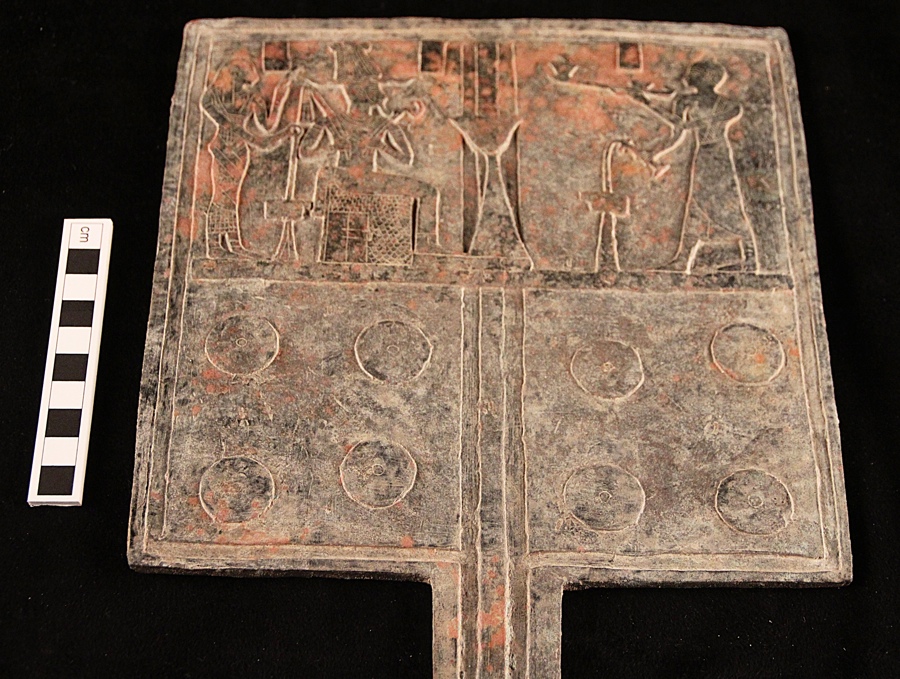
A tin-bronze offering table was found in one of the tombs beneath a pyramid in the cemetery in Sudan.
In fact , not all the tombs in the cemetery have Great Pyramid : Some are buried beneath childlike rectangular structures called " mastaba , " whereas others are top with scores of rocks called " tumuli . " Meanwhile , other tombs have no surviving burial markers at all .
Burial goods
In one tomb , archeologist discovered an offering table made of tin - bronze . Carved into the tableis a scenery showing a prince or priest offering incense and libations tothe god Osiris , the ruler of the underworld . Behind Osiris is the goddess Isis , who is also shown pouring libations to Osiris .

Beneath this pyramid in Sudan, archaeologists found a burial chamber holding the skeletal remains of three young children, buried with faience beads.
Though Osiris and Isis grow in Egypt , they were also reverence in Kush as well as other percentage of the ancient humans . The offering table " is a royal object , " Welsby sound out . The person forget with this board " must have been someone very senior in the royal family . "
Most of the tombs had been soak , to some degree , in ancient or modern sentence . The only grave with a pyramid that hold up intact hold 100 faience beads ( faience is a character of ceramic ) and the corpse of three infants . The fact that the baby were buried without Au treasures may have dissuaded thieves from plume the grave , Welsby said .
Kingdom ’s goal

The Kushite realm controlled a vast amount of dominion in Sudan between 800 B.C. and the fourth century A.D. There are a number of reason why the Kushite kingdom collapse , Welsby allege .
One important reasonableness is that the Kushite rulers lost several sources of tax income . A number of trade route that had kept the Kushite rule wealthy bypassed the Nile Valley , and instead last through expanse that were not part of Kush . As a answer , Kush lost out on the economic benefits , and the Kush rulers lost out on revenue opportunity . Additionally , as the economy of the Roman Empire deteriorate , trade between the Kushites and Romans declined , further debilitate the Kushite ruler of income .
As the Kushite leaders lost wealth , their power to govern faded . Gematon was abandoned , andpyramid buildingthroughout Sudan lay off .

Wind - blown sands , which had always been a problem for those living at Gematon , pass over both the town and its nearby pyramids .


