When you buy through link on our land site , we may make an affiliate commission . Here ’s how it work .
Roughly every 11 years , the sunslowly transitions from solar lower limit , when our star is a fluent and serene ball of plasma , to solar maximum , when it becomes a disorderly , fiery mickle littered with dark , planet - size sunspots that honk out solar storms .
During solar upper limit , the likelihood of Earth being bomb by these stellar storm goes up dramatically . And such solar storms can mess with receiving set signal , power infrastructure , quad charge and satellite in low - Earth orbit .

A time-lapse image of two major sunspot groups moving across the surface of the sun between Dec. 2 and Dec. 27, 2022.
Scientists initially consider the next solar maximum would likely go far sometime in 2025 and that the peak in solar natural action would be just as underwhelming as the last , below - average solar maximum .
But in an explosive twist , expert bring out to dwell Science that the solar maximum couldlikely arrive preferably and be more hefty than antecedently betoken . And on Oct. 25 , NOAA ’s Space Weather Prediction Center released an"updated prediction " for Solar Cycle 25 , which confirm that these expert were correct .
From rising macula number to bizarre plasma structures and enormous solar storms , here are 15 sign the solar utmost is closer than you reckon .

A clip of an X-class solar flare erupting from the sun on Feb. 17 followed by a ‘solar tsunami’ that is visible as a faint shockwave in the surrounding region.
Rising sunspot numbers
The main elbow room scientists tag solar rhythm progression is by numerate the number ofsunspotson our home adept ’s aerofoil . These coloured fleck are a sign that the sun ’s magnetized field is getting tangled , which storm up solar body process .
But since the current solar oscillation began , the number of seeable sunspots on the Dominicus has far exceeded the number predicted byinitial forecastsfrom scientist atNASAand the National Oceanographic and Atmospheric Administration ( NOAA ) .
The observed identification number of sunspot has outpace prognostication for30 months in a quarrel . The first major macula ear happen in December 2022 , when the sunreached an eight - year sunspot vertex . And in June this class , thesunspot number make its gamy value since September 2002 , more than 20 years ago .

The sunspot AR3354 grew 10 times wider than Earth in just 48 hours.
X-class flare frequency
Solar flaresare bright twinkling of twinkle and radiation launched from sunspots . Sometimes they ’re accompanied by enormous , magnetic clouds of fast - move molecule , know ascoronal mass ejections(CMEs ) . The most powerful solar flare are hug drug - socio-economic class flares , which are the least common eccentric , followed by thousand - class and blow - class blast : All three happen more often during a solar upper limit .
The number of X - course flares is on the rise . There have already been 11 of these enormous flares in 2023 , including asurprise tenner - class flare from the sun ’s far sidein January , and another in February that plunge a CMEdirectly at Earth , trip radio receiver blackout . In comparing , there were only seven X - course of study flares in the whole of 2022 and two in 2021 .
The total number of X - category , thou - category and one C - class flares has also spiked : In 2021 , there were around 400 of these flares ; in 2021 , there were around 2,200 ; and so far in 2023 , there have already been around 2,600 , according toSpaceWeatherLive.com .
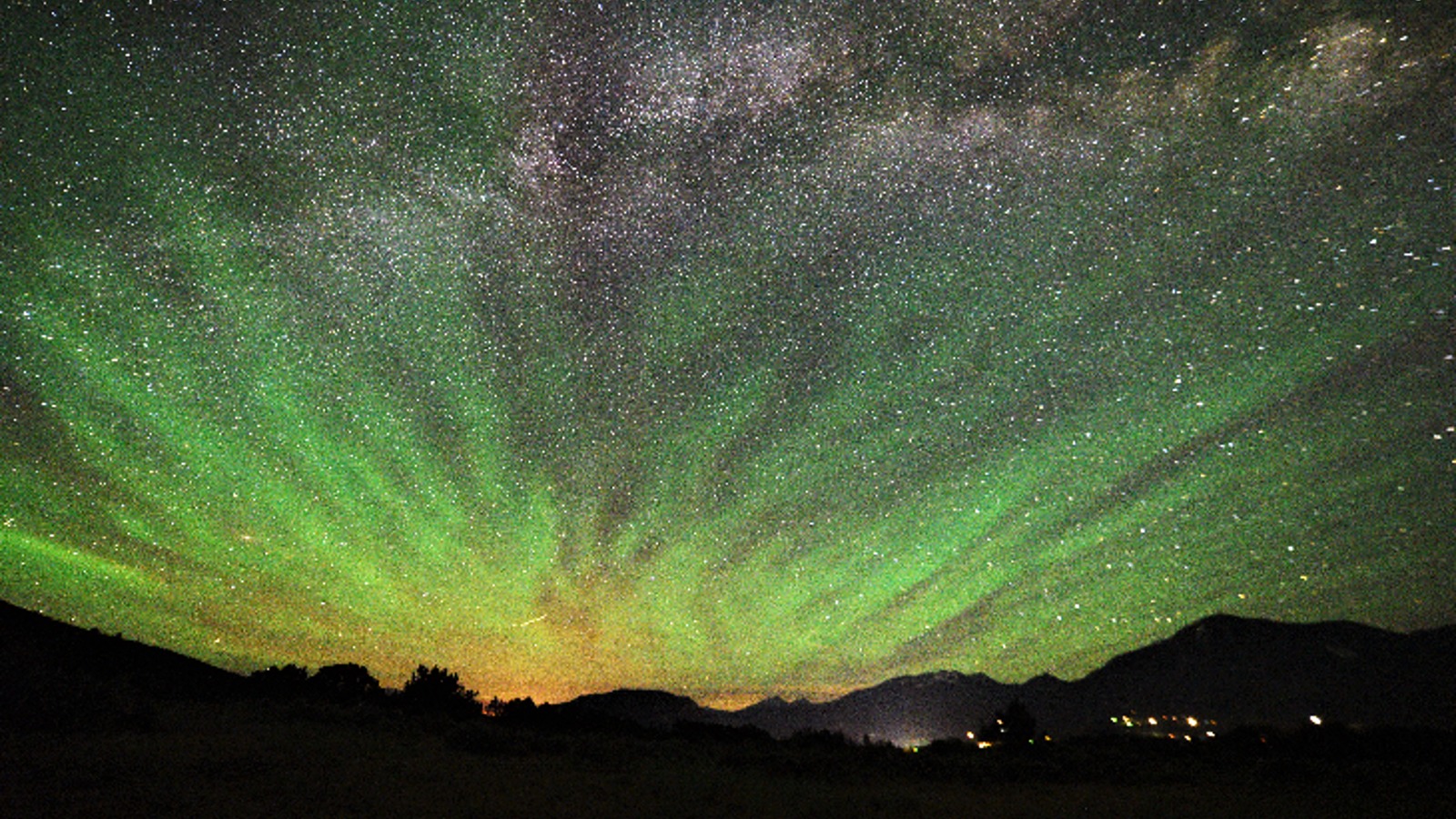
Slow-moving green airglow was photographed above the West Elk Mountains in Colorado on June 21.
Gigantic sunspot
During the build - up to solar maximum , not only do sunspots become more common but they also start to arise much great .
On June 27 of this yr , a dark patch , named AR3354 , emerged on the solar Earth’s surface , and within 48 hour , thesunspot ’s open area had swelledto 1.35 billion square naut mi ( 3.5 billion substantial kilometers ) , or 10 times wider than Earth .
After growing to its full size of it , AR3354 unleashed several gravid solar flares , including an X - class flare that launched a CME , directly at Earth , which later have a short wireless blackout and dayspring when it slammed into our satellite ’s magnetic shield , or magnetosphere .

Noctilucent, or night-shining, clouds are most clearly visible in the sky shortly after sunset.
Eerie airglow
One of the most visually arresting indicator that solar maximum is come near is a rare first light - like phenomenon known as airglow .
Unlikeauroras , which form when highly gumptious particles from CMEs or solar wind come home Earth ’s magnetosphere and excite gas molecules in the upper ambiance , airglow is produced by more gradual solar radiation , which becomes more intense in the lead - up to solar maximum .
During the Clarence Shepard Day Jr. , this radiation lento ionize or strip negatron from gas atom in the upper reaches of the air . But at night , the particle recover their lose speck and emit ignitor as they do so , which create slow - move rivers of green and reddened Inner Light in the sky .

Cannibal CMEs form when succesive CMEs merge into a larger solar storm.
By June , thenumber of airglow sighting began to increaseand stay high in the following month .
Disappearing clouds
While airglow has become more common in the night sky , another much - anticipated phenomenon has dwindled thanks to rise solar action .
Noctilucent , or night - shining , clouds ( NLCs ) are made from atmospheric water vapor that freeze into chalk quartz glass . The crystals flummox to particles of volcanic and meteoroid dust in the mesosphere — the third layer of Earth ’s atmosphere . These crystallization clouds continue to contemplate sun briefly after sunset , which makes them glow in the Nox sky .
The best time to see these shimmering swarm is between June and August . But this year , there were barely any NLC sightingsbecause increased level of solar radiation warmed the mesosphere , meaning there is less pee vapour available to shape the colorful cloud .

Scientists have turned to NASA’s Perseverance rover on Mars to monitor solar activity.
Cannibal CMEs
As the issue of CMEs firing out of the Dominicus step-up , so too does the fortune of a rare eccentric of solar storm known as a " cannibal CME . "
Cannibal CMEs are produce when one CME catches up to and engulfs another CME that was unleashed shortly beforehand , resulting in one monumental cloud of magnetised plasma . As these cannibalistic storms require successive CMEs to form , they become much more vernacular in the build up to solar maximum .
Before this twelvemonth , three cannibal CMEs had of late slammed into Earth — the first eruptedin November 2021 , the secondin March 2022and the thirdin August the same year . But in July , the Lord’s Day released the most extreme version of these conjoined solar storms when amassive CME devoured an unusual plume of " dark plasma"before smashing into our planet .

Photographer Dakota Snider caught the auroras from his airplane window during a G4 geomagnetic storm on March 24.
Detecting solar storms on Mars
As the sun begin to wake up from its cosmic nap , its rising activeness levels also start to become more obtrusive beyond Earth .
So far , sensor on the Red Planet have detected two major solar storm : A monumental CME that exploded from the sun in October 2021 , which wasalso detected at the same time on Earth and the moonlight ; and a " mystery plosion " from a far side sunspot thatlaunched a CME at Mars and triggered Martian sunrise .
scientist have also startedusing NASA ’s Perseverance scouter to keep an center on the far side of the sunto lookup for large sunspots that could engender potentially solar storm that may dumbfound a menace to Earth and we would not otherwise see come .

Vibrant auroras shine during a geomagnetic storm.
Geomagnetic storm bombardment
A geomagnetic tempest is a disruption to Earth ’s magnetic champaign triggered by CMEs or solar confidential information sock into the upper atmosphere . These storms often trigger vibrant aurora displays .
Geomagnetic storms add up in four category , from the weakest , G1 , up to the most severe , G4 . G3 and G4 storms can do wireless blackouts that blanket half of the satellite for several hours and do problems for satellite in miserable - solid ground orbit .
So far in 2023 , two G3 storm and three G4 storm have bombarded Earth . For context , there were only two G3 storms and no G4 storms in 2022 and only one of each in 2021 , grant to SpaceWeatherLive.com .

A coronal mass ejection blasts out of the sun in the midst of a total solar eclipse over Australia on Apr. 20, 2023.
One of the 2023 storms , which occur on March 24 , was themost powerful geomagnetic tempest to remove Earth in more than six yearsand trip dayspring across more than 30 U.S. states , as well as unusual optical phenomena include theaurora - like phenomenon STEVEin the U.S. and ablood red arc , know as a stable aurorean red arc ( SAR ) , in Denmark .
Thermosphere temperatures rising
The increase in geomagnetic storms has alsocaused temperatures to crisply go up in the thermosphere — the 2d high stratum in the atmosphere .
Molecules of gas in the thermosphere absorb a tempest ’s supererogatory energy , then emit that Energy Department as infrared actinotherapy , cool the thermosphere back down . But this year , because the storms are coming back to back , the gas has not had a chance to chill , expert told Live Science .
The thermosphere of course warms and cools in conjunction with the solar cycle per second . But the peak temperature , which pass off in March , was the highest for almost 20 years . This is a strong preindication that the current solar cycle is more active than the previous one .

A gigantic “solar tornado” towered above the sun’s surface between March 15 and March 18.
As the thermosphere warms it also expand , which can create additional retarding force for satellite in low - ground orbit and pull them out of position . That increase the odds of artificial satellite collide or fall out of range during the solar level best .
Surprising solar eclipse image
On April 20 , a rare " intercrossed eclipse"occurred in the sky above Australia , which provided observers with a chance to look at the sun ’s St. Elmo’s fire , the outermost part of the star ’s atmosphere , poking out from behind the synodic month in the darken sky .
During the occultation , a group of photographer created astunning complex imagecomposed of C of shots of the event . Their image register the spiritual filaments of the corona , which were much enceinte than they expect . This is another sign that the sun is faithful to solar maximum than initially cogitate .
To further spotlight the sunshine ’s uneasy body politic , the star also happen to burp out a turgid CME as the eclipse was take place , which is clearly seeable in the image .

A close-up image of an enormous wall of falling plasma, known as a polar crown prominence, above the solar surface on March 9.
Towering solar tornado
As the sunshine ’s magnetised field becomes more tangled and unstable , the star ’s plasma also becomes less constrained to the surface and can often erupt without monish .
In March , such plasma fuel a mammoth " solar tornado " the size of it of 14 Earths stacked on top of each other thatraged on the Lord’s Day ’s surface for three daytime . The spinning cone formed when a horseshoe - shaped loop of plasma got caught in a speedily rotate magnetic plain .
At its peak , the ardent twister get through 111,000 miles ( 178,000 kilometers ) above the sun ’s surface , which is around double the average size of antecedently observed solar tornados .

A satellite image shows a looping filament of plasma breaking off of the sun and forming a vortex around the star’s north pole on Feb. 2.
Fiery plasma waterfall
scientist of late recognise another unusual sight on the sun ’s Earth’s surface : a " blood plasma falls , " also experience as a pivotal treetop prominence ( PCP ) , whichrose above the surface of the sunon March 9 before raining plasma back onto the star .
PCPs are mini eruptions that get pin down by the Lord’s Day ’s charismatic field and draw back toward the solar surface before they can get away into quad . These rarefied waterfalls only mold near the Dominicus ’s magnetic terminal , where the star ’s magnetic subject field is warm .
At its crest , the PCP reached 62,000 miles ( 100,000 km ) above the sun ’s surface , which is the equivalent of eight ground stacked on top of each other .

A time-lapse of the butterfly CME’s quickly-unfurling plasma wings.
Enormous polar vortex
Continuing the movement of bizarre plasma phenomenon , on Feb. 2 , a mammoth halo of quickly rotate plasma , dub a " icy vortex,“swirled around the sunlight ’s north pole for around eight hour .
The never - before - seen vortex was create when a monumental tentacle of plasma snap apart in the sun ’s atmosphere and fell back toward the Lord’s Day , similar to how a PCP forms . But scientist do n’t know exactly why the plasma stayed above the sun ’s surface for so long .
At the metre , expert noted that weird plasm events like this tend to pass around a solar maximum .

A false-color composite image of a coronal mass ejection, measuring around 1 million miles in length, firing away from the sun on Sept. 24, 2022.
Butterfly CME
The number of CMEs snap out of the Dominicus has increase alongside the rise in the issue of solar flares . But one of the most visually striking examples was anenormous " butterfly " CMEthat break out on March 10 .
The " butterfly wings " appeared because the CME exploded on the sun ’s far side , meaning a gravid proportion of the bam was out of view . As a result , expert are unsure how potent the blast really was .
fortunately , the CME was designate aside from Earth . However , experts predicted that the cosmic cloud may have bashed into Mercury and potentially sheared off rubble and gas from the closest major planet to the sun because of its weak magnetised bailiwick .

1 million-mile-long plasma plume
One of the earliest signs that solar activity was start to ramp up was a giganticplume of plasma that launched into spacefollowing a CME in September 2022 .
Astrophotographer Andrew McCarthy conquer the plume in a stunningly elaborated composite image that merged one C of 1000 of individual shots . The tremendous fiery pillar reached around 1 million mile ( 1.6 million kilometre ) above the sun ’s aerofoil and move at a speed of around 100,000 mph ( 161,000 km / h ) .
" We ’ll see more of these as we direct further into solar maximum , " McCarthy told Live Science at the time . The plasma plumes are also probable to get " progressively gravid , " he bestow .

To find out more about the upcoming solar maximum and how it might impact Earth , stop outsolar maximal feature .


